
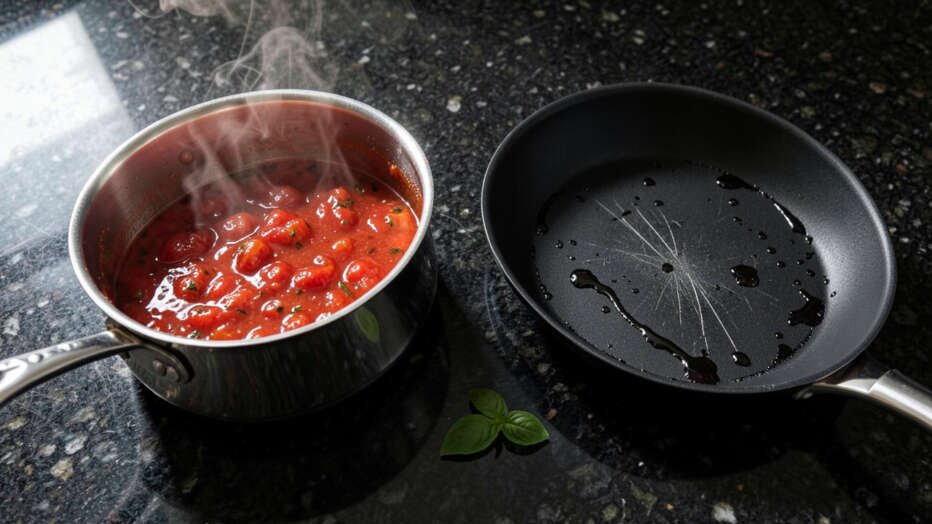
Stainless steel wins for acidic sauces over non-stick because its chromium oxide layer resists acid reactions and prevents metal leaching. Non-stick coatings degrade when exposed to acids like tomato or citrus, causing flaking and potential chemical release even in PFOA-free varieties. For any acidic sauce, stainless steel provides superior chemical safety, heat tolerance, and durability, typically lasting decades compared to non-stick’s one to three years.
Tomato sauce can ruin a good non-stick pan in one meal. This guide explains why stainless steel wins for acidic sauces over non-stick and how to choose the right cookware.
Quick Verdict: Simply put, stainless steel resists acid reactions, does not leach chemicals, and handles high heat. Non-stick coatings break down when exposed to acids, causing flaking and chemical release. For any sauce with tomatoes, citrus, or vinegar, stainless steel is the safer, longer-lasting choice.
Here is a side-by-side comparison of how each material performs with acidic sauces.
| Feature | Stainless Steel | Non-Stick | Winner |
|---|---|---|---|
| Acid Resistance | No reaction with acids | Coating degrades over time | Stainless Steel |
| Heat Tolerance | Up to 500+ degrees F | Usually under 450 degrees F | Stainless Steel |
| Browning Ability | Excellent – develops fond | Poor – minimal browning | Stainless Steel |
| Chemical Leaching Risk | Minimal in 18/10 steel | PTFE release above 500 F | Stainless Steel |
| Durability | Decades with care | 1 to 3 years typically | Stainless Steel |
| Ease of Cleaning | Requires technique | Easy until coating fails | Non-Stick (short term) |
The data shows a clear pattern. Stainless steel wins for acidic sauces over non-stick in almost every category that matters for long cooking sessions.
Key Takeaways
- Stainless steel does not react with acidic ingredients like tomatoes, citrus, or vinegar, which means your sauce stays safe and pure.
- Non-stick pans lose their coating faster when exposed to acids, leading to flaking and chemical release into your food.
- You can develop deeper flavor with stainless steel because it allows browning and fond formation that non-stick prevents.
- Stainless steel handles high heat needed for searing meat before adding sauce, while non-stick degrades above 450 degrees F.
- Choosing stainless steel for acidic sauces saves you money in the long run since the pan lasts decades instead of years.
Important: The difference between good and bad cookware for acidic sauces comes down to chemistry. Acids react with reactive metals like aluminum and copper. Non-stick coatings protect the metal, but the coating itself breaks down. Stainless steel is inert, so it does not react at all.
What Makes Stainless Steel Ideal for Acidic Sauces?
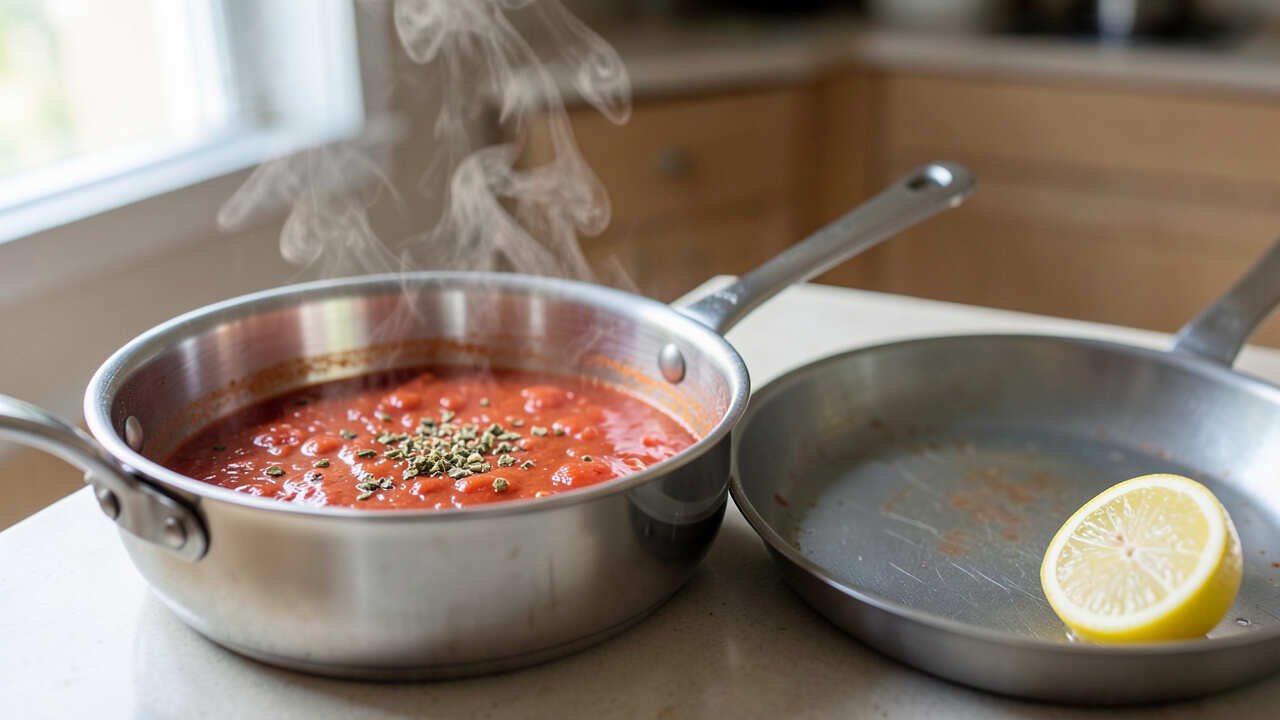
Stainless steel is an alloy made from iron, chromium, and other metals. The chromium creates a thin, invisible layer of chromium oxide on the surface. This layer is what makes stainless steel “stainless” and chemically inert.
When you cook acidic foods in stainless steel, the chromium oxide layer protects the metal underneath. According to the US Food and Drug Administration, stainless steel is considered food-safe and does not react with acidic foods under normal cooking conditions.
How the Metal Composition Matters
Not all stainless steel is the same. The best grade for cookware is 18/10 stainless steel. That means 18 percent chromium and 10 percent nickel. The nickel adds stability and corrosion resistance.
- 18/10 stainless steel – The gold standard for cookware. Maximum corrosion resistance and minimal leaching.
- 18/8 stainless steel – Almost as good. Slightly less nickel but still safe for acidic sauces.
- 18/0 stainless steel – Less expensive but more prone to corrosion. Not ideal for acidic cooking.
- 304 grade stainless steel – The industry name for 18/8. Common in professional kitchens.
- 316 grade stainless steel – Added molybdenum for extra corrosion resistance. Overkill for home use but excellent.
Warning: Avoid using low-grade stainless steel (18/0 or 430 grade) for long simmers of tomato sauce. These steels have less chromium and can leach iron and nickel into your food, giving it a metallic taste.
The Role of the Chromium Oxide Layer
The chromium oxide layer is self-healing. If you scratch the surface, oxygen in the air reacts with the chromium to rebuild the protective layer. This is why stainless steel lasts for decades.
According to the American Chemical Society, the passive layer on stainless steel is about 3 to 5 nanometers thick. That is roughly 1/10,000th the width of a human hair. Yet it provides complete protection against acid attack.
This means you can simmer tomato sauce for hours without worrying about metal leaching or flavor changes. The sauce stays true to its ingredients.
Why Does Non-Stick Struggle with Acidic Sauces?
Non-stick pans rely on a coating applied to an aluminum or stainless steel base. The most common coating is PTFE, also known by the brand name Teflon. This coating creates a slick surface that food slides off easily.
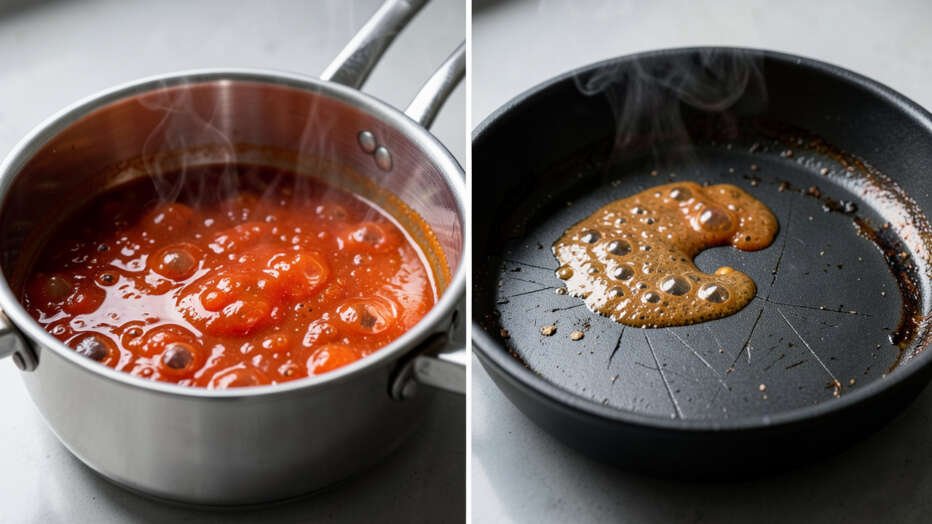
However, PTFE coatings have known weaknesses with acidic food. The acid in tomatoes, citrus, vinegar, and wine slowly attacks the coating. Over time, the coating weakens, bubbles form, and pieces flake off into your food.
The Science of Coating Degradation
Acids break down the chemical bonds that hold the non-stick coating to the pan. This process speeds up with heat. The Environmental Working Group has reported that non-stick coatings can start to degrade at temperatures as low as 450 degrees F.
- Chemical breakdown – Acids attack the polymer bonds in PTFE coatings.
- Blisters and bubbles – Gas forms beneath the coating, creating raised areas.
- Flaking – The coating peels off in small pieces that mix with your sauce.
- Loss of non-stick – Food starts sticking to the damaged areas.
- Exposed metal – The aluminum or steel underneath gets directly exposed to acid.
Once the coating starts failing, you cannot fix it. The pan becomes unsafe because you might eat coating fragments. The only solution is to replace the pan.
Warning: If you see any scratches, chips, or peeling on your non-stick pan, stop using it for acidic foods immediately. The Centers for Disease Control and Prevention notes that ingesting non-stick coating particles can cause gastrointestinal irritation in some people.
Why PFOA-Free Does Not Solve the Acid Problem
Many modern non-stick pans are labeled PFOA-free. PFOA is a chemical that was used in the production of older non-stick coatings and has been linked to health problems. While PFOA-free coatings are an improvement, they still use PTFE and remain vulnerable to acid degradation.
The PFOA-free label only means the pan was made without that specific chemical. It does not mean the coating resists acid better or lasts longer. Acidic sauces will still break down PTFE regardless of whether the pan contains PFOA.
Head-to-Head Comparison
Chemical Safety
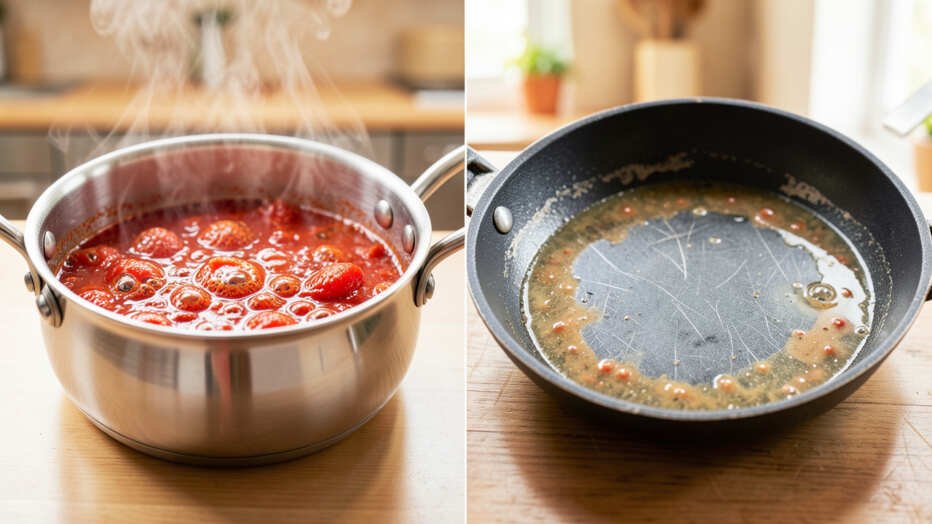
Chemical safety is the first reason stainless steel wins for acidic sauces over non-stick. Stainless steel is chemically inert. The chromium oxide layer prevents any reaction between the metal and your food.
Non-stick coatings are not inert. They contain fluoropolymers that can break down. When PTFE degrades, it can release chemicals that are toxic to birds and potentially harmful to humans. The USDA’s Food Safety and Inspection Service recommends using pans that do not break down under normal cooking conditions.
For acidic sauces that simmer for 30 minutes or more, the extended heat and acid exposure increase the risk of coating failure. Stainless steel eliminates this risk entirely.
Cooking Performance
Performance matters just as much as safety. Stainless steel does not have a non-stick surface, so food can stick if you do not use the right technique. However, that sticking is what creates browning and flavor.
When you brown meat or vegetables in stainless steel, the browned bits that stick to the pan are called “fond.” Fond is the foundation of flavor for pan sauces. When you add wine, stock, or tomato juice to the hot pan, the fond dissolves into the liquid. This process is called deglazing.
- Fond development – Only happens in pans that allow browning. Non-stick prevents this.
- Deglazing potential – Creates rich, complex sauce flavors from the browned bits.
- Heat control – Stainless steel responds quickly to temperature changes.
- Even heating – Multi-layer stainless steel distributes heat evenly across the surface.
- Oven safety – Most stainless steel pans can go in the oven up to 500 degrees F.
Non-stick pans excel at low-fat cooking of delicate foods like eggs and fish. For acidic sauces that start with browning meat, non-stick falls short. You cannot create fond, and the sauce will lack depth.
Long-Term Value
The upfront cost of a good stainless steel pan is higher than a non-stick pan. However, the cost per use is much lower over time.
A quality stainless steel pan costs 50 to 150 dollars. It lasts 20 to 30 years with proper care. A non-stick pan costs 20 to 60 dollars. It needs replacement every 1 to 3 years. Over 10 years, the stainless steel option saves you money.
| Cost Factor | Stainless Steel | Non-Stick |
|---|---|---|
| Upfront price | 50 to 150 dollars | 20 to 60 dollars |
| Average lifespan | 20 to 30 years | 1 to 3 years |
| Cost per year | 2.50 to 7.50 dollars | 7 to 60 dollars |
| Resale value | Moderate to high | None |
The financial math is clear. Even the most expensive stainless steel pan pays for itself within a few years compared to buying new non-stick pans every year.
Which One Should You Choose?
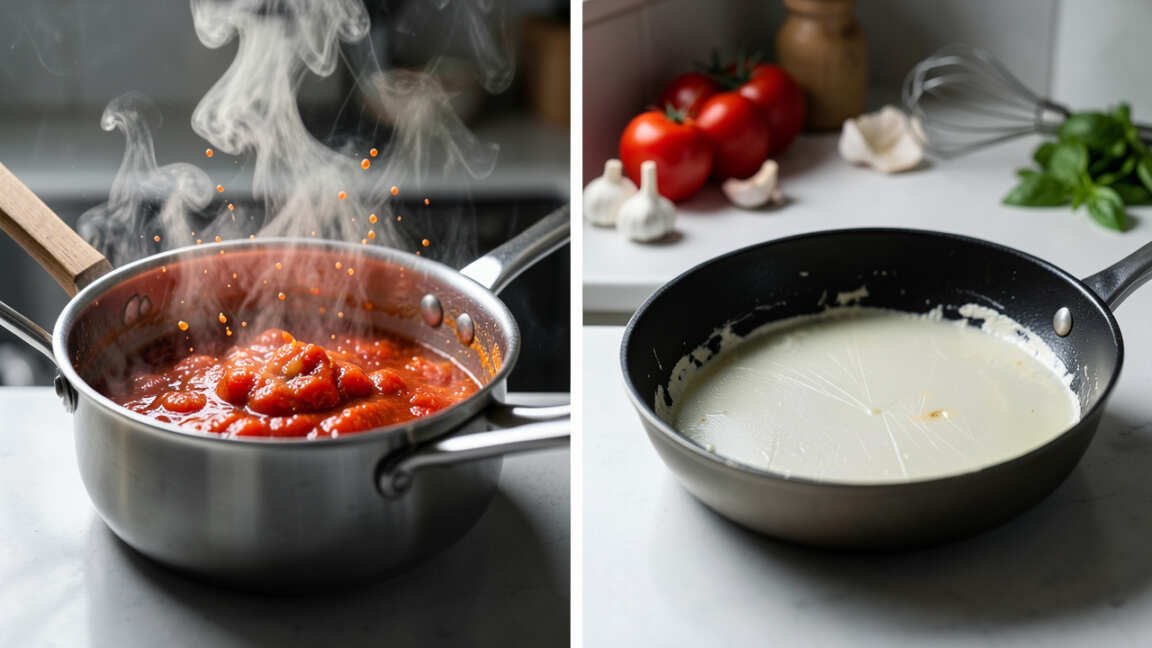
This decision depends on what you cook most often. For some kitchens, owning both types makes sense. Here is how to decide.
Choose Stainless Steel If You
- Cook tomato-based sauces, curries, or stews regularly
- Want to develop deep flavor through browning and deglazing
- Cook at high temperatures or finish dishes in the oven
- Prefer cookware that lasts more than a few years
- Are concerned about chemicals leaching into food
Keep Non-Stick If You
- Cook eggs, fish, or delicate pancakes several times a week
- Prefer easy cleanup without effort
- Use little to no oil in your cooking
- Replace pans frequently and stay on top of coating conditions
- Cook only at low to medium heat
Many professional chefs keep one or two non-stick pans for eggs and fish. They use stainless steel for everything else, especially sauces. This hybrid approach gives you the best of both worlds.
Tip: If you buy only one type of pan for acidic sauces, make it stainless steel. A good 10-inch stainless steel skillet can handle tomato sauce, searing, deglazing, and oven finishing. It does everything non-stick does except the easiest egg flip.
Common Myths vs Facts
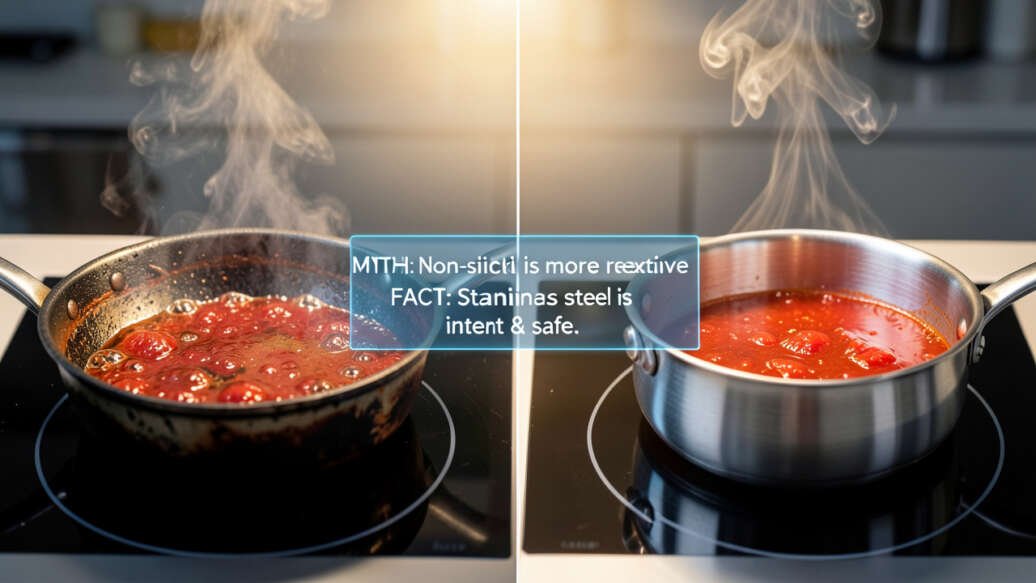
Several myths persist about cooking with stainless steel and non-stick pans. Here are the facts.
Myth 1: “Stainless steel is impossible to cook with because everything sticks.”
This is the most common complaint about stainless steel. The truth is that sticking happens when you do not preheat the pan properly or use too little fat. If you heat the pan until water droplets bead up and skitter across the surface, the pan is at the right temperature. Add oil, let it heat, then add your food. Food releases naturally when it forms a crust.
Myth 2: “Non-stick pans are perfectly safe at any temperature.”
Non-stick pans are not safe above 450 to 500 degrees F. The Food and Drug Administration advises that overheated non-stick can release fumes that cause polymer fume fever in humans and can be fatal to pet birds. Always keep non-stick heat at medium or lower.
Myth 3: “A scratched non-stick pan still works fine for cooking.”
A scratched non-stick pan does not work fine. The scratches create gaps in the coating where food can stick and where chemicals can leach. Once you see any metal through the coating, it is time to replace the pan. The Consumer Product Safety Commission recommends replacing non-stick cookware that shows any signs of wear. The Food and Drug Administration advises that overheating non-stick pans can release harmful fumes.
Frequently Asked Questions
Can I use non-stick pans for tomato sauce?
You can, but the acid in tomatoes will degrade the non-stick coating over time. The process is gradual, so one pot of pasta sauce will not ruin the pan. However, regular use of acidic sauces will shorten the pan’s lifespan and increase the risk of coating flaking.
Does stainless steel leach nickel into acidic foods?
The chromium oxide layer on stainless steel prevents leaching in normal use. High-quality 18/10 stainless steel is very stable. According to the European Food Safety Authority, nickel migration from stainless steel cookware is far below safe limits for most people. Those with severe nickel allergies may want to use enameled cast iron instead.
How do I clean stainless steel after cooking acidic sauces?
Let the pan cool, then soak it in warm soapy water for 10 to 15 minutes. Use a non-abrasive sponge to remove stuck-on food. For stubborn stains from tomato sauce, add a splash of vinegar or use a dedicated stainless steel cleaner like Bar Keepers Friend.
What is the best stainless steel pan for acidic sauces?
Look for pans labeled 18/10 or 304 stainless steel with a tri-ply construction (steel-aluminum-steel). Brands like All-Clad, Cuisinart, and Tramontina offer excellent options. The tri-ply layer ensures even heat distribution and prevents hot spots that can cause sticking.
Why does my stainless steel pan leave a metallic taste in my food?
This usually happens with low-grade stainless steel or when cooking very acidic foods for a long time. The metallic taste comes from tiny amounts of iron or nickel leaching into the food. Switch to high-quality 18/10 stainless steel, or try using enameled cast iron for extra-long simmering sessions.
Final Thoughts
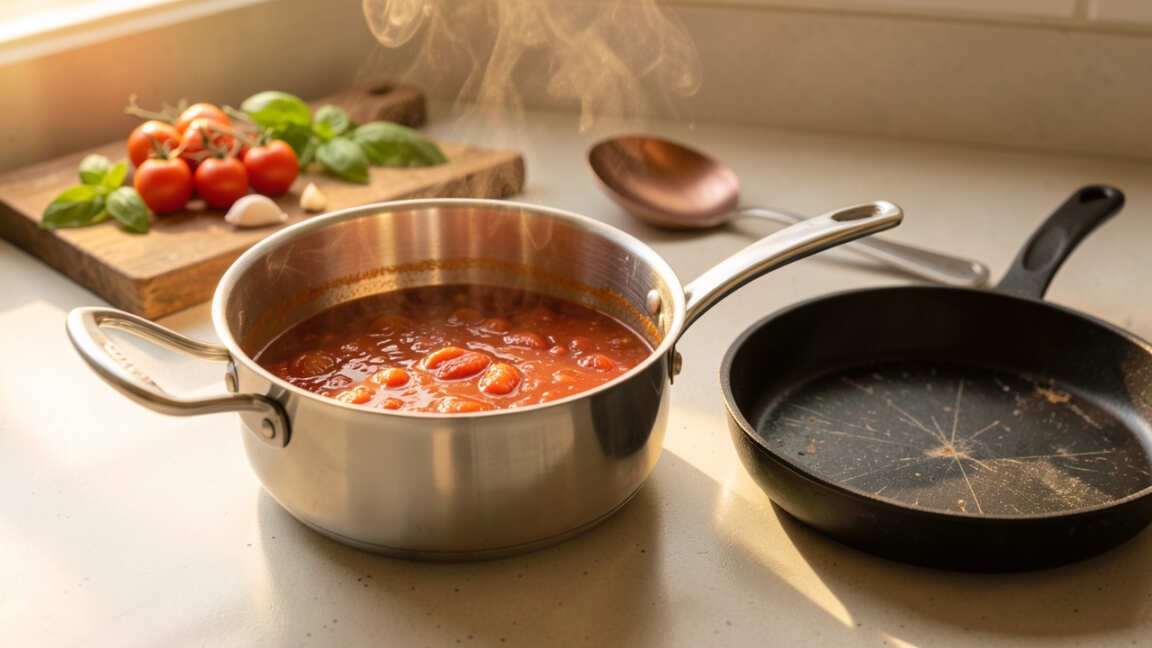
Stainless steel gives you safety, durability, and better flavor when cooking acidic sauces. Non-stick pans have their place for eggs and delicate fish, but they cannot handle the heat and acid that stainless steel manages with ease. Invest in one good stainless steel skillet and it will serve you through thousands of meals.

Leave a Reply