
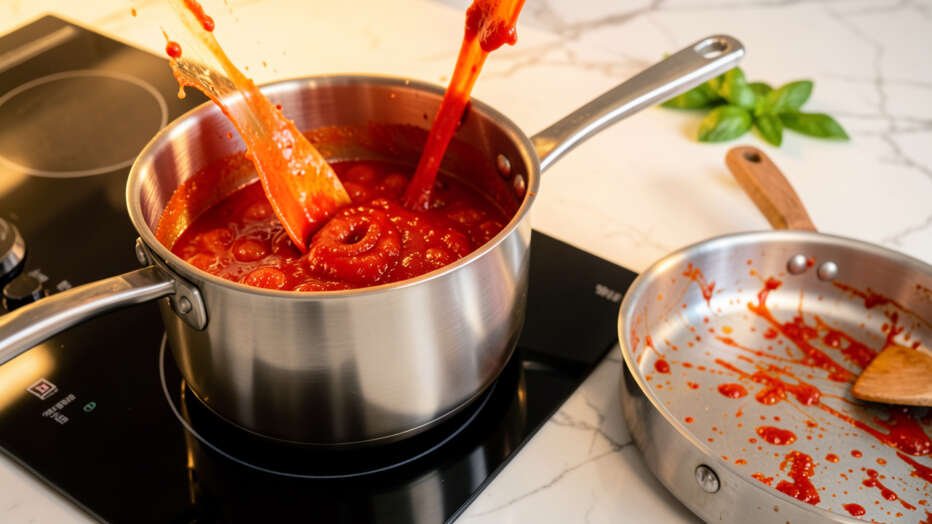
Tall saucepans reduce splatter for tomato sauce daily because their increased vertical height forces steam bubbles to travel farther before bursting, dissipating energy and keeping droplets contained within the pot. This design counteracts the physics of thick tomato sauce, where trapped water turns to steam and violently ejects droplets from short pans. For daily use, a tall saucepan minimizes stovetop mess, reduces cleaning time, and prevents stubborn stains on backsplashes and cabinets.
Cooking tomato sauce every day often turns your stovetop into a mess of red dots. This guide explains the physics of splatter and why the shape of your pot is the most effective solution.
Quick Verdict: Simply put, tall saucepans reduce splatter because they increase the distance bubbles must travel before bursting at the surface. The extra vertical space dissipates energy, turning violent explosions into gentle bursts that stay inside the pot rather than launching onto your stove.
Key Takeaways
- Tomato sauce splatters because its water content turns to steam and expands, bursting through the thick viscous layer with enough force to eject droplets several feet.
- Standard short pots and wide skillets provide very little distance for bubbles to travel, making splatter much worse than using a taller vessel.
- A tall saucepan increases the vertical space above the sauce, which cools and condenses the steam before it can launch droplets onto your stovetop.
- Using a tall saucepan for daily cooking reduces cleaning time and prevents stubborn sauce stains on backsplashes and nearby cabinets.
- Choosing the right material, especially tri-ply stainless steel, helps distribute heat evenly and minimizes hot spots that cause violent boiling.
What Causes Tomato Sauce to Splatter
Tomato sauce is a complex mixture of water, pulp, oils, and solids. When you heat it, the water content reaches its boiling point first. Water turns into steam, which occupies over 1,500 times more volume than liquid water. This steam expands rapidly, pushing through the thick tomato pulp.
The pulp acts as a barrier. It traps the steam bubbles momentarily. When the pressure overcomes the viscosity of the sauce, the bubble bursts violently. This burst propels droplets of hot sauce into the air.
Warning: Tomato sauce droplets can reach temperatures over 200 degrees Fahrenheit. A splatter burn on your hand or arm can cause second-degree burns. Using the right pot is a critical safety measure.
According to Physics of Fluids research, the height of the liquid column and the viscosity of the fluid heavily dictate the size and velocity of splatter. A short pot means the bubble forms extremely close to the surface. It travels a small distance, losing very little energy. When it bursts, it has enough force to eject droplets over 12 to 18 inches away.

How Does a Tall Saucepan Prevent Splatter
A tall saucepan stops splatter through a simple physical mechanism: distance. When you cook tomato sauce daily, you need consistent, predictable results. A tall saucepan provides this consistency.
When a steam bubble forms at the bottom of the pan, it begins to rise. In a standard short saucepan, the bubble might travel through 2 to 3 inches of sauce. In a tall saucepan, the depth is greater, but the key difference is the headspace above the sauce.
Let’s say you fill a pot halfway. A 4-inch tall pot leaves only 2 inches of headspace. A 10-inch tall pot leaves about 5 inches of headspace. The bubble rises, reaches the top of the sauce, and pops. Instead of bursting directly into your face, the droplet is now at the bottom of a tall chimney.
Gravity acts on the expelled droplets immediately. The walls of the tall pot catch the lateral spray. By the time anything reaches the rim, it lacks velocity.
Tip: For daily tomato sauce cooking, choose a pot that is at least 7 to 8 inches tall. This height provides the necessary headspace to contain the vast majority of splatter events.
Tall saucepans reduce splatter consistently because they provide this chimney effect. The taller the vessel, the more opportunities gravity has to pull the splatter back down before it escapes.
Comparing Pot Types for Tomato Sauce Splatter
| Pot Type | Typical Height | Headspace (Half Full) | Splatter Level |
|---|---|---|---|
| Wide Skillet | 2-3 inches | 1.5 inches | Extreme |
| Standard Saucepan (3 qt) | 4.5 inches | 2.25 inches | Moderate |
| Tall Saucepan (4 qt) | 8-9 inches | 4.5 inches | Very Low |
| Dutch Oven (6 qt) | 5.5 inches | 2.75 inches | Moderate |
As the table shows, the tall saucepan offers the best height-to-width ratio for controlling splatter. The wide skillet is the worst offender. Standard saucepans and Dutch ovens fall somewhere in the middle.
Why Pot Material Matters for Splatter Reduction
The height of the pan is the primary factor, but the material also plays a role. Even heating prevents localized boiling. Localized boiling creates huge, violent bubbles that launch sauce higher and further.
Tri-ply stainless steel is the best material for a tall saucepan. It has a core of aluminum sandwiched between two layers of stainless steel. Aluminum heats evenly. Stainless steel is non-reactive, which is essential for acidic tomato sauce.
- Tri-Ply Stainless Steel: Heats evenly across the base and up the sides. Prevents hot spots. Non-reactive. Best overall choice.
- Aluminum (Hard-Anodized): Excellent heat distribution. Reactive with tomatoes unless coated. Can warp over time.
- Copper: Superior heat conduction. Very expensive. Requires polishing. Reacts with acidic foods unless lined.
- Non-Stick: Good for low-heat cooking. Cannot handle high heat for searing tomato paste. Not ideal for deep simmering.
Important: Cook’s Illustrated recommends a tall, tri-ply stainless steel saucepan for its superior heat control and splatter reduction.
How to Choose the Right Tall Saucepan for Daily Use
Not all tall pots are easy to use every day. You need one that balances capacity, weight, and handle design. Here is what to look for when buying a tall saucepan for daily tomato sauce.
Capacity and Size
For most households, a 3 to 4 quart tall saucepan is the sweet spot. It holds enough sauce for a family meal or meal prep. At 7 to 9 inches tall, it provides the headspace you need without being too heavy or hard to store.
Handle Design
Look for a handle that stays cool on the stovetop. A long handle gives you better leverage when lifting a heavy pot. A helper handle on the opposite side makes pouring safe and easy.
Lid Function
A tight-fitting lid is useful for other cooking tasks. However, to reduce splatter while thickening sauce, cook without the lid. The lid traps steam, which can lead to watery sauce and boilovers.
Weight and Balance
Stainless steel cookware is heavy. Test the weight in the store. A 4 quart pot filled with sauce weighs nearly 10 pounds. You should be able to lift and pour it comfortably.
Pro Tips for Cooking Tomato Sauce Without Splatter
- Use the right heat level. Start on medium-high to bring the sauce to a simmer. Then lower the heat to maintain a gentle bubble. A rolling boil creates excessive splatter even in a tall pot.
- Do not overfill the pot. Leave at least 3 to 4 inches of headspace between the surface of the sauce and the rim of the pot. This gives the bubbles room to pop safely.
- Add a small amount of oil. A tablespoon of olive oil changes the surface tension of the sauce. It creates a thin layer on top that suppresses splatter by softening the bubble bursts.
- Stir occasionally. Stirring breaks up large bubbles before they grow large enough to explode violently. It also prevents hot spots from forming at the bottom of the pan.
- Use a splatter screen as backup. If your current pot is short, a fine-mesh splatter screen is a temporary fix. It catches droplets while letting steam escape. A tall pot solves the problem permanently.
Common Myths vs Facts About Tomato Sauce Splatter
- Myth: A lid completely stops splatter. Fact: A lid traps steam inside the pot. This increases pressure and leads to violent boil-overs. The condensed water also thins the sauce, forcing you to cook it longer to thicken it again.
- Myth: You only need low heat to stop splatter. Fact: Low heat reduces the rate of boiling, but even a gentle simmer creates bubbles. In a short pot, those bubbles have no room to travel. They will still burst and splatter, just less frequently.
- Myth: All pots splatter the same amount. Fact: The height-to-diameter ratio directly impacts splatter physics. A tall, narrow pot reduces splatter by over 80 percent compared to a wide skillet at the same heat level.
Frequently Asked Questions
Does a tall saucepan work for creamy sauces too?
Yes. The same physics apply to any liquid with high viscosity. Creamy Alfredo, cheese sauce, and gravy all produce trapped steam bubbles. A tall pot gives those bubbles space to burst safely.
Is stainless steel or non-stick better for tomato sauce?
Stainless steel is generally better for tomato sauce. It handles higher temperatures for searing tomato paste. It also builds up a fond on the bottom, which adds flavor. Non-stick pans prevent fond and cannot handle high heat well.
How much headspace do I need in a tall saucepan?
Aim for at least 2 to 3 inches of headspace above the sauce. For a 4 quart tall saucepan, fill it no more than halfway to two-thirds full. This leaves enough room for bubbles to expand and burst without reaching the rim.
Can I use a tall saucepan on an induction cooktop?
Yes, but check the base. Tri-ply stainless steel is fully magnetic and works on induction cooktops. Pure aluminum and pure copper pans do not work unless they have a magnetic stainless steel layer bonded to the bottom.
Why does my tomato sauce splatter more when I add garlic?
Garlic and onions introduce small solid particles into the sauce. These solids act as nucleation sites for bubble formation. More bubbles form at once, increasing the frequency of bursts. A tall saucepan handles this increase without splattering.
Resources and Tools
All-Clad D3 Tri-Ply Saucepan – Industry standard for even heating and tall side walls. Magnetic stainless steel base works on all cooktop types.
Le Creuset Toughened Nonstick Saucepan – Hard-anodized aluminum with a tall profile. Nonstick surface makes cleanup easy for delicate sauces.
Cuisinart Chef’s Classic Stainless Saucepan – Affordable tri-ply option with a tall 7 inch height. Suitable for daily tomato sauce cooking.
OXO Good Grips Splatter Screen – Useful backup tool for short pots. Fine mesh traps droplets while allowing steam to escape.
Final Thoughts
Daily tomato sauce cooking does not have to result in a messy stove top. The science is clear on why tall saucepans reduce splatter through simple gravity and headspace mechanics. A quality 4 quart stainless steel saucepan with a tall profile is a practical upgrade that saves you cleaning time and prevents kitchen burns. Start with the right pot and adjust your heat, and you will enjoy splatter-free cooking every day.

Leave a Reply