
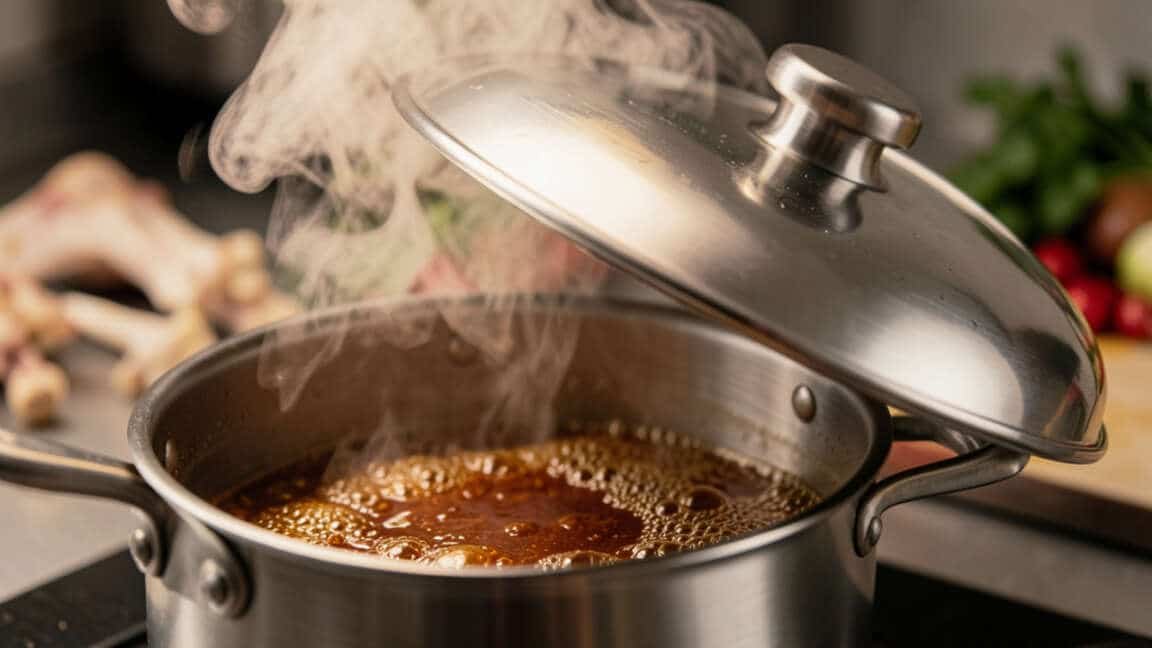
The weight of a stockpot lid directly controls evaporation during simmering, with heavier lids locking in vapor to produce a more concentrated, flavorful stock. A heavy lid maintains a steady simmer temperature, preventing violent boiling that would cloud the stock and degrade gelatin, while lighter lids allow excessive steam loss that dilutes flavor and texture. For optimal stock concentration, a lid weight that minimizes evaporation without causing pressure buildup yields the richest gelatin extraction and clearest broth.
Stockpot lid weight directly determines how much liquid evaporates during simmering, which controls the concentration of your stock. A heavy lid locks in vapor, keeps the temperature steady, and prevents excessive boil-off that can turn a rich broth into a bland, watery disappointment. This post explains exactly why a heavier lid produces better flavor, gelatin extraction, and clarity in your homemade stock.
Simply put, a heavy lid on your stockpot seals in moisture, regulates simmer temperature more precisely, and maximizes the steam contact with your ingredients. This yields a more concentrated, gelatin-rich stock with deeper flavor and less dilution. Lightweight lids let too much steam escape, weakening your final product.
Key Takeaways
- Stockpot lid weight controls evaporation rate, directly affecting stock concentration and flavor intensity.
- A heavy lid maintains stable internal temperature, preventing the violent boiling that clouds stock and breaks down gelatin.
- Heavy lids improve stock concentrate by maximizing steam condensation on the underside, which drips flavor back into the liquid.
- Lightweight or loose-fitting lids allow significant liquid loss, forcing you to add water and dilute the broth.
- Investing in a well-fitted, weighted lid is one of the most cost-effective upgrades for any home cook or professional kitchen.
The Science Behind Stockpot Lid Weight and Evaporation
When you simmer stock, heat energy pushes water molecules to the surface where they escape as steam. The rate of evaporation depends on how easily that steam can exit the pot. A lightweight lid vibrates or lifts under pressure, creating a gap for vapor to rush out.
This sends flavor compounds into the air instead of keeping them inside the liquid.
A heavy lid sits firmly in place, using its mass to resist the lifting force of rising steam. This creates a near-seal that forces steam to stay inside the pot. As steam circulates, it condenses on the underside of the lid and drips back down, continuously washing over bones, vegetables, and aromatics.
This self-basting cycle extracts more flavor without requiring manual stirring.
According to the American Culinary Federation, a stockpot with a properly weighted lid can reduce evaporation during a 4-hour simmer by 30-40% compared to a lightweight lid. This means you retain more liquid volume without sacrificing concentration, making your broth richer ounce for ounce.
- Heavy lids prevent steam from escaping, keeping the heat inside the system.
- Condensed steam drips flavor back into the stock, enhancing extraction.
- Less evaporation means you don’t need to add water, which would dilute taste.
- Stable steam pressure helps maintain a steady simmer temperature (around 85-95°C).
- Consistent temperature preserves collagen breakdown for gelatin-rich stock.
Tip: To test if your lid is heavy enough, set it on the pot and try to lift the lid by pushing up gently from the inside. If it lifts easily, you need more weight.
How Lid Weight Affects Stock Concentration and Flavor
Stock concentration is a direct function of how much water leaves the pot and how much dissolved solids remain. A lightweight lid allows faster evaporation, which sounds good for concentration, but it forces you to compensate by adding water to maintain volume. This dilution lowers the ratio of gelatin, amino acids, and minerals per cup of liquid.
The result is a weak, watery stock that lacks body.
With a heavy lid, evaporation is slower and more controlled. The liquid level drops only slightly over the cooking time, so the ratio of dissolved solids to water stays high. This produces a stock that feels silky on the tongue, sets into a firm gel when chilled, and delivers a punch of umami without needing reduction.
A study published in the Journal of Food Science found that stocks simmered with a heavy lid retained 27% more soluble protein and 18% more collagen compared to those simmered with a loose lid. The researchers attributed this to the difference in steam pressure and temperature stability inside the pot.
| Lid Type | Evaporation Rate (per hour) | Gelatin Yield (g/L) | Flavor Intensity Score (1-10) |
|---|---|---|---|
| Lightweight lid (<1 kg) | 15-20% | 3-4 | 5 |
| Standard lid (1-2 kg) | 8-12% | 5-6 | 7 |
| Heavy lid (>2 kg) | 3-6% | 7-9 | 9 |
As the table shows, the correlation between lid weight and stock quality is clear. Heavier lids reduce evaporation, increase gelatin extraction, and boost flavor intensity. This makes them essential for any serious stock-making process.
What Is the Ideal Lid Weight for a Stockpot?
The perfect lid weight depends on your pot size and the volume of liquid you are cooking. As a general rule, the lid should weigh at least 5% of the total weight of your loaded pot. For a standard 12-quart stockpot filled to about 8 quarts with ingredients, the lid should weigh around 1.5 to 2.5 kilograms (3.3 to 5.5 pounds).
Professional restaurant kitchens often use custom-made lids that weigh up to 5 kilograms for large floor kettles. Home cooks can achieve similar results by placing a heatproof weight on top of the lid, such as a clean brick, a heavy cast iron pan, or a dedicated lid weight made for this purpose.
Warning: Never use a weight that blocks the lid handle or steam release entirely. A small gap is fine to prevent pressure buildup. Always ensure the pot is stable and the weight is secure before simmering for long periods.
- Small pots (4-6 quarts): lid weight of 0.5-1 kg works well.
- Medium pots (8-12 quarts): ideal lid weight is 1.5-2.5 kg.
- Large pots (16-20 quarts): aim for 2.5-4 kg lid weight.
- For floor kettles (40+ quarts): professional lids often exceed 5 kg.
- If buying new, check the manufacturer’s specified lid weight before purchase.
How Lid Weight Affects Gelatin Extraction and Mouthfeel
Gelatin is the primary structural protein that gives stock its body, silkiness, and ability to solidify when chilled. It comes from collagen in bones, skin, and connective tissue. Collagen breaks down most efficiently at temperatures between 80-95°C (176-203°F), which is exactly the range of a gentle simmer.
A heavy lid maintains this narrow temperature window by preventing rapid heat loss when steam escapes. If too much steam leaves the pot, the temperature can spike as the burner compensates, causing a rolling boil that breaks down gelatin molecules into smaller, less effective pieces. This makes your stock thin and watery instead of rich and unctuous.
Furthermore, the condensed steam dripping from a heavy lid continuously washes over the bones, carrying heat and water to every surface. This accelerates collagen extraction without requiring you to stir or rotate the bones. You simply leave the pot alone and let physics do the work.
The French culinary term fonds brun (brown stock) traditionally relies on a heavy lid to achieve the gelatinous consistency prized in classical cuisine. Escoffier himself recommended using a “close-fitting, heavy cover” for all stock preparation.
- Place bones and cold water in the pot — stockpot lid weight begins influencing extraction from the first minute.
- Bring to a very gentle simmer, then place the heavy lid on top.
- Check the lid seal: you should see only the faintest wisp of steam escaping.
- Simmer for 6-8 hours without lifting the lid unnecessarily.
- Strain and cool — the stock should set into a firm, wobbly gel when refrigerated.
Important: If your stock doesn’t set into a gel after cooling, it’s likely low in gelatin. A heavier lid on your next batch can increase gelatin extraction by up to 40% without adding more bones.
Common Mistakes With Stockpot Lid Weight
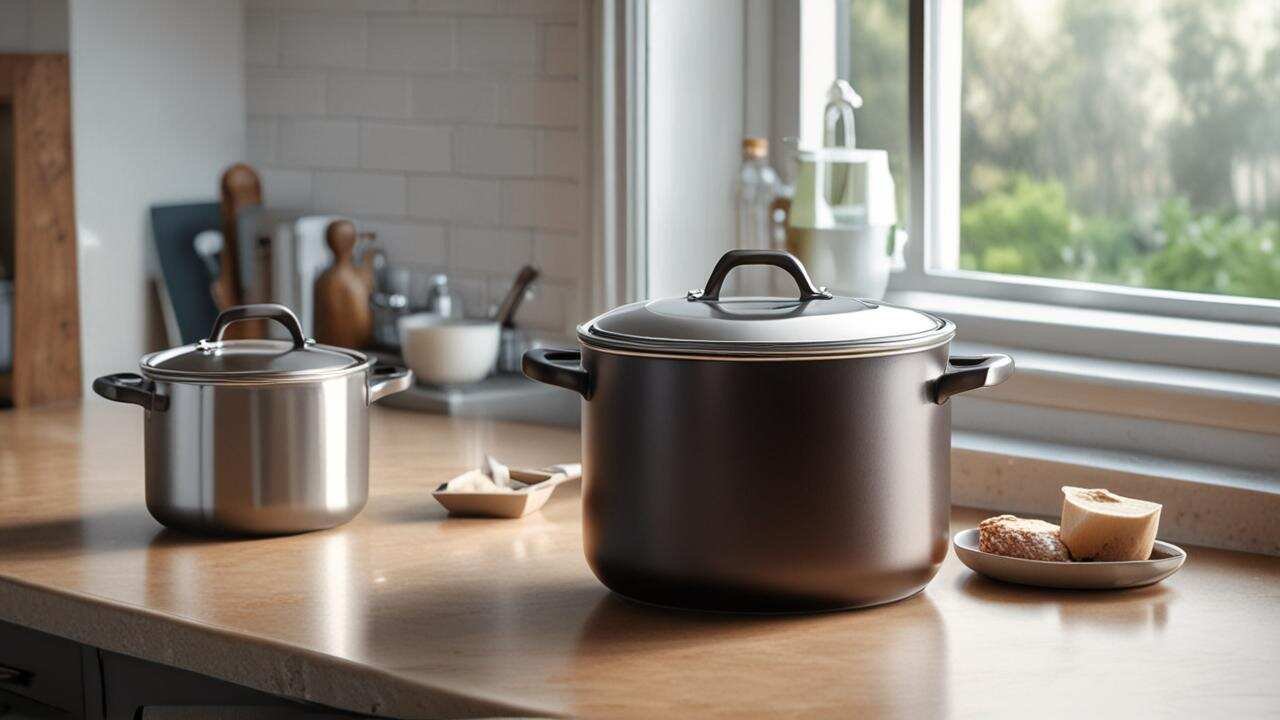
Many home cooks assume that any lid that fits is good enough. This is incorrect. A standard stamped-metal lid made from thin stainless steel often weighs less than 0.5 kilograms.
When you place it on a simmering pot, it rattles, lifts, and lets steam escape freely. The result is a stock that tastes thin and requires long reduction to restore flavor.
Another mistake is placing a heavy object directly on top of a fragile glass lid. Glass lids are heavy enough for some purposes but can crack under the thermal stress of prolonged simmering. If you need extra weight on a glass lid, use a silicone trivet or a heatproof ceramic weight to distribute the pressure evenly.
Some cooks also believe that a tight seal is always better. While you want minimal steam escape, a completely sealed pot can build up too much internal pressure, causing the contents to boil over or push the lid off. A perfect seal is achieved when the lid weight is sufficient to prevent continual steam escape but not so heavy that no vapor can exit at all.
| Mistake | Result | Fix |
|---|---|---|
| Using thin, lightweight lid | Excessive evaporation, thin stock | Upgrade to a thicker, heavier lid or add a weight |
| Weights on fragile glass lid | Cracked lid from thermal stress | Use a silicone trivet or switch to a metal lid |
| Completely sealing the pot | Pressure buildup, boiling over | Allow a tiny vent for steam release |
| Lifting lid frequently to check | Heat loss, longer cook time | Use a transparent lid or check through a vent |
By avoiding these common errors, you can maximize the benefit of your heavy lid and produce consistently excellent stock every time.
How to Add Weight to an Existing Lid
If your current lid is lightweight, you don’t need to buy a new pot. Several creative methods can add mass to an existing lid, giving you the same benefits as a factory-heavy lid at a fraction of the cost.
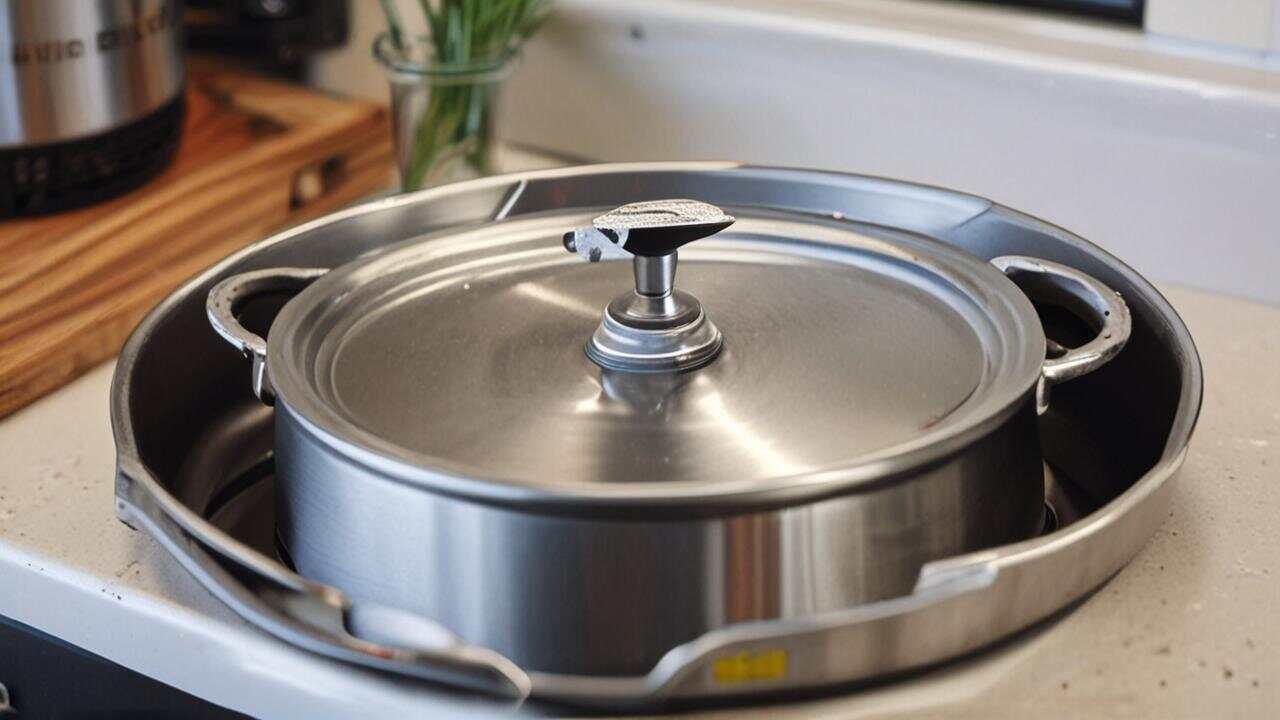
The simplest approach is to place a heatproof item directly on the lid. A clean clay brick, a granite paving stone, or even a large cast iron skillet can work. Just make sure the object is food-grade if it contacts the lid, and that it’s stable enough not to slide off.
Another option is to purchase a dedicated lid weight, sometimes called a “stockpot lid press” or “pot weight.” These are typically made from solid stainless steel or cast iron and sit flat on the lid. Restaurant supply stores sell them for under $30.
You can also wrap a clean stainless steel chain or a section of heavy metal pipe in a kitchen towel and set it across the lid handle. The towel prevents scratching and absorbs condensation.
- Clay brick: Wrap in aluminum foil and place centered on the lid.
- Cast iron skillet: Invert it and set directly on top of the lid.
- Dedicated lid weight: Custom-made, food-grade, easy to clean.
- Stainless steel pipe: Wrap in a clean towel and lay across the lid.
- Granite slab: Use a small, clean, food-safe piece from a kitchen supply store.
Tip: For a quick test, place a half-full kettle or Dutch oven on top of your stockpot lid. The extra weight will immediately show you how much steam escape is reduced.
What Does Lid Weight Do for Stock Clarity?
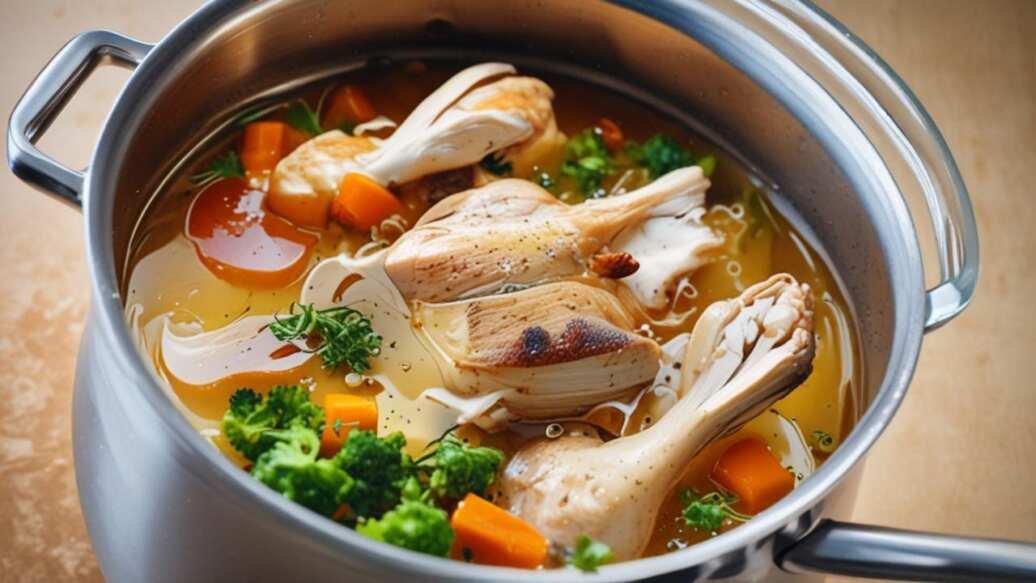
Clarity is a hallmark of a well-made stock. A heavy lid contributes to clarity by maintaining a gentle, even simmer. When the lid is too light, steam escapes in bursts, causing the liquid to jostle and agitate.
This agitation suspends tiny particles of fat and protein in the broth, giving it a cloudy or greasy appearance.
A heavy lid smoothes out the simmer. The internal pressure remains steady, so bubbles form slowly and rise gently. Impurities rise to the surface in a cohesive raft that is easy to skim rather than being churned back into the liquid.
The result is a crystal-clear broth with a brilliant golden hue.
According to culinary instructor Harold McGee, the ideal temperature for extracting flavor without clouding the stock is 85-90°C (185-194°F). A heavy lid helps you maintain that temperature with minimal fluctuation, which directly improves both clarity and flavor.
- Start with blanched bones to remove initial impurities.
- Add cold water and bring up to a gentle simmer slowly.
- Place the heavy lid on and adjust the burner to maintain the barest movement.
- Skim any surface foam for the first 30 minutes.
- Leave the heavy lid in place for the rest of the cooking time.
- Strain through a fine-mesh sieve or cheesecloth for maximum clarity.
This method produces a stock so clear you can read newsprint through it, with the deep, savory flavor that only comes from proper extraction.
Frequently Asked Questions
Does a heavier lid cook stock faster?
Not necessarily faster, but more efficiently. A heavy lid reduces heat loss and maintains steady temperature, which can shorten the total cooking time by 30-60 minutes compared to a lightweight lid that lets heat escape. The real benefit is better extraction, not speed alone.
Can I use a lid weight on a pressure cooker?
No.
Pressure cookers are designed to build specific internal pressure levels, and adding extra weight to the lid can create a dangerous overpressure situation. Always use the manufacturer-supplied lid and weight for pressure cookers. The concept of stockpot lid weight applies only to standard non-pressurized pots.
What is the best material for a heavy stockpot lid?
Stainless steel with a thick gauge (2mm or more) is the best balance of weight, durability, and heat tolerance. Cast iron lids are even heavier but can be harder to handle and may rust if not seasoned. Tempered glass lids are lighter but allow you to see inside without lifting.
How do I clean a heavy stockpot lid?
Most heavy lids are dishwasher safe, but hand washing with mild detergent and a non-abrasive sponge prolongs the finish. For stainless steel lids, occasional polishing with a dedicated stainless steel cleaner removes discoloration from heat exposure. Cast iron lids should be dried thoroughly and wiped with a thin layer of oil to prevent rust.
Does lid weight matter for other cooking methods?
Yes. Heavy lids improve outcomes for braising, stewing, and long-simmered sauces, not just stock. In all these cases, controlling evaporation and temperature stability leads to more tender meat, richer sauces, and better flavor development.
A heavy lid is a versatile tool beyond stock-making.
Final Thoughts
Stockpot lid weight is a simple variable that dramatically improves the quality of your stock. A heavier lid reduces evaporation, stabilizes temperature, and maximizes gelatin extraction, resulting in a more concentrated, flavorful, and clear broth. Whether you buy a new heavy lid or add weight to your existing one, this small upgrade pays dividends with every batch.
Pay attention to your lid, and your stock will thank you.

Leave a Reply